• Artists/Producers
  • Sync
    • Videos – Sync
    • Sync Updates
  • Gear Guides
  • Elements
    • About Us
  • Contact
Disco Logo

Our Favorite Sync Licensing Tool for 2026: DISCO.ac

February 9, 2026 by 3theorymusic
Gear Guide, Sync Licensing

Our Favorite Sync Licensing Tool for 2026

Our Search for THE ONE

One question we frequently get asked is about what tools we use to manage our songs and keep our pitching organized. I will say, we researched and tried out a LOT of services; well over 15 different companies all aiming to be the solution for independent labels, licensing agents, music supervisors and independent artists looking to pitch their own music. A lot of the known players like Synchtank, Soundgizmo, and SourceAudio are out of budget for most start-ups or solo operations. Furthermore, the design and user experience for most are bulky and not something I was proud to send to clients.

Warning: I’m about to sound like a fanboy but I’m not an employee nor was I compensated by Disco to write this. However, after literally years of searching and easily spending over a 100 hours testing options, it’s understandable that I’d want to gush a bit when I finally find “the one.”


Do You Disco?

When I was first introduced to Disco, a music catalog manager and pitching app, I couldn’t believe that one company had finally hit all the notes I was looking for. Disco was designed from the ground up by music supervisors for music supervisors. It was initially used as an internal tool for their team to pitch music, keep track of those pitches, organize playlists, manage metadata, and collaborate with other members of their group. They soon saw the hole in the market for an easy to use catalog manager that didn’t forget about aesthetics! And so, Disco was offered to the public.


What’s Love Got to Do With It

One of the big missing features in other services was an elegant way to pitch your playlists. Soundcloud had a nice looking player but you couldn’t easily share hi-res WAV, AIF and MP3 files with it. Box, Dropbox and the rest are okay but quickly auditioning songs is not easy and you can’t check the lyrics while listening to a song.


Enter DISCO.ac

With Disco you can customize each of the playlists you send out with background images and custom logos/artwork. All of the playlists allow the end user to download MP3’s, WAV/AIF or both! Within the same one-page playlist they can also view lyrics without interrupting the music player and you can add custom notes (ie – “this artist is on tour with John Mayer” or “this is a cover song but we’ve cleared it easily in the past”).

All of the playlists you send out can be assigned unique URL’s that are linked to the emails of the person you’re sending them too (or you can send them directly using Disco’s internal email form). All of which can be tracked and instantly reported with Disco’s analytics. You can see immediately when someone has opened your playlist, streamed or downloaded a song or downloaded the entire playlist!

One of the coolest features is that you can upload just one hi-res file and Disco will automatically create a MP3 version. No more managing separate MP3 and hi-res files!

Take It to the Outro

I could go on and on about my favorite features (not to mention the fact they they are remarkably better priced that any of the other options out there), but if you’re interested I would highly suggest you contact the fine folks at Disco and set up a one-on-one walk-through. When I did my Zoom call with them, they made specific suggestions on how to organize my catalog for the specific work we do at 3 Theory Music and it literally eliminated 2 spreadsheets I was using to keep track of where my music was going and where it had been. Give Disco a try and let me know what you think! Find us on Instagram –> @3TheoryMusic.


*If you found any value from this, we’d appreciate you using our referral affiliate link. You’ll get $20 credit on your Disco subscription:
Disco Sign-Up Link.


GIK Acoustics: It’s Not You, It’s Your Room

February 11, 2024 by 3theorymusic
Acoustics and Studios, Gear Guide, Recording and Mixing

Bounce the mix. Go to the car. Bounce the mix. Go to the car. Descend back into the mixing room, hoping you didn’t just mix yourself out of a great song. Repeat until the sun disappears, as well as your hair.

I would do this well-practiced ritual maybe 20 times a mix. It’s the physical form of watching the spinny-wheel of death on your computer. Just endless. 

Listening to your mixes through your car speakers is a great technique, which I continue to do, but now I only go back a few times a mix and move on. 

So, what is the magic bullet to keep your process effective and moving?

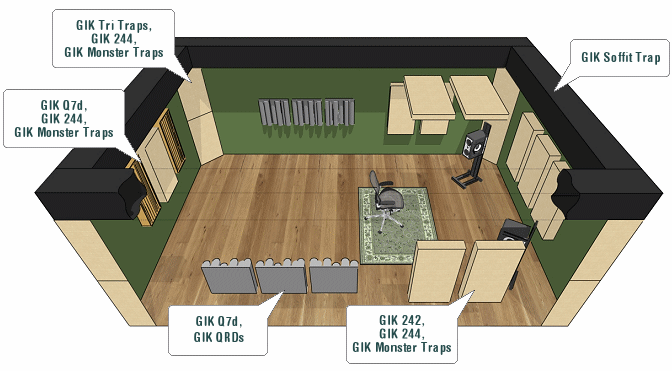
Room treatment! For me, getting unstuck from this endless second-guessing cycle was most notably due to making my space free from unwanted sound reflections. Even if you have great speakers, without giving some sort of thought to this, your ears will continue to be fooled by frequencies building up or canceling each other out in your room.

Acoustics are complicated. Wall materials, density, and even temperature and humidity can play into how sound is absorbed or reflected in a room. 

For example, a low E on a bass guitar can have a wavelength of over 13 feet. If you’re in a space that can’t accommodate that, you’ll have trouble mixing low frequencies — and that can throw off your entire mix.


Room treatment vs. sound proofing.

So what’s the difference between room treatment and soundproofing?

A lot of people get this mixed up, but there’s a big difference. Soundproofing is about blocking sound from entering a space, a process that involves tearing down walls and rebuilding. It’ll cost you a pretty penny, and if you don’t own your space, you just can’t do it. 

But room treatment is all about balancing the frequencies that are created within a room. We’re enhancing the space, and anyone can do it. 


Keep in mind, no room is perfect!
Every space has nodes and nulls, which, respectively, either build up and amplify the frequencies or cancel each other out to make them sound quieter than they actually are. Acoustic treatment helps even out those nodes and nulls to give you an accurate perception of the music you’re hearing. 

At some point in everyone’s music career, we all will have to think about this at least a little bit. 

The good news is a little bit is all you have to do to start.


My recommendation 

I wish I would have known about the secrets behind all of this earlier. After I dove into the world of room treatment, my mixes got better so much faster, and I’d like to help save you some time if I can.

Luckily, we don’t have to spend years analyzing sound waves and the psychoacoustic elements of sound frequencies. There are professionals who understand and, perhaps more importantly, have simplified it so that we don’t have to. 

If I was a cheerleader, I would absolutely be shouting, “Give me a G! Give me an I! Give me a K!” 

The GIK Acoustics team has helped me design and prioritize treatments for the last two studios I’ve built. And I can’t sing their praises enough. There are some great room treatment companies out there (e.g. RealTraps.com and ioAcoustics.com) but GIK Acoustic offers great products and a lot of free education tools that have been extremely valuable to me in each of my studio builds. They’re easy to connect with, they’re professional, and they have quality products. Right now, I have a combination of GIK, ioAcoustics, and custom made bass traps in my studio.


Working with a budget

GIK has a completely free service that helps you understand your room and how to best treat it.

I actually used their guidance from this free service for a long time before I was able to invest in their recommendations. If you visit their website, you can enter information about your space and they’ll get back to you with recommendations on how to treat your specific space. (No strings attached — really!) They’ll even help you prioritize the most effective items first if your budget doesn’t allow for everything. 


Do your future self a favor!

I’ve been working remotely as an engineer since before it was cool. I used to work in an untreated bedroom, staring at a basket of laundry while plugging away. It wasn’t ideal, and besides it being a poor sound space, I didn’t feel like a professional producer when I looked around me. Believe it or not, the way you feel in a studio also makes a difference, and sound treatment makes your studio feel amazing.

To be perfectly blunt, spending money on room treatments is not fun. I’d rather invest in a new instrument or microphone, but if I had to build a studio from scratch, I would invest in room treatments and speakers first — especially if I was planning to do my own mixing. Doing this will save you time, money, valuable energy, and it will make your music sound much more professional. So either way, if you’re ready to invest or not, use GIK’s free service and thank me later! 


Geek out corner

Want to dig even deeper? GIK has plenty of helpful articles and educational resources. 

They also offer a free room analysis and recommendations. No catches and no purchase needed. They’ll help you even if you decide not to purchase from them: GIK free advice.
For more fun wavelength information, feel free to also geek out over this chart about wavelengths.

Recent Posts

  • Our Favorite Sync Licensing Tool for 2026: DISCO.ac
  • NEFF and the Court: Keeps Showing Up on Screen
  • GIK Acoustics: It’s Not You, It’s Your Room
  • Singer-Songwriter KRAMIES announces new EP with help from the rosters of Black Keys, Grandaddy, Band of Horses and Train.
  • Nintendo Switch ad featuring Neff and the Court debut single

Categories

  • Acoustics and Studios
  • Fresh News
  • Gear Guide
  • Recording and Mixing
  • Sync Licensing

Newsletter

Grab our Monthly Newsletter and stay tuned

Follow Us


2020 © Copyright –  All Rights Reserved – Website by 3theorymusic.com